The first deck we built rather than repaired.
Memory4 / 4 MB
Slots2
Released2018
StatusWithdrawn
Price—
Est. 2011 · Cyberdecks & service
Most of what we know about building decks we learned from taking apart ones that could not be repaired. Every deck we make opens with one size of driver, and we hold parts for each mark for ten years after we stop making it.
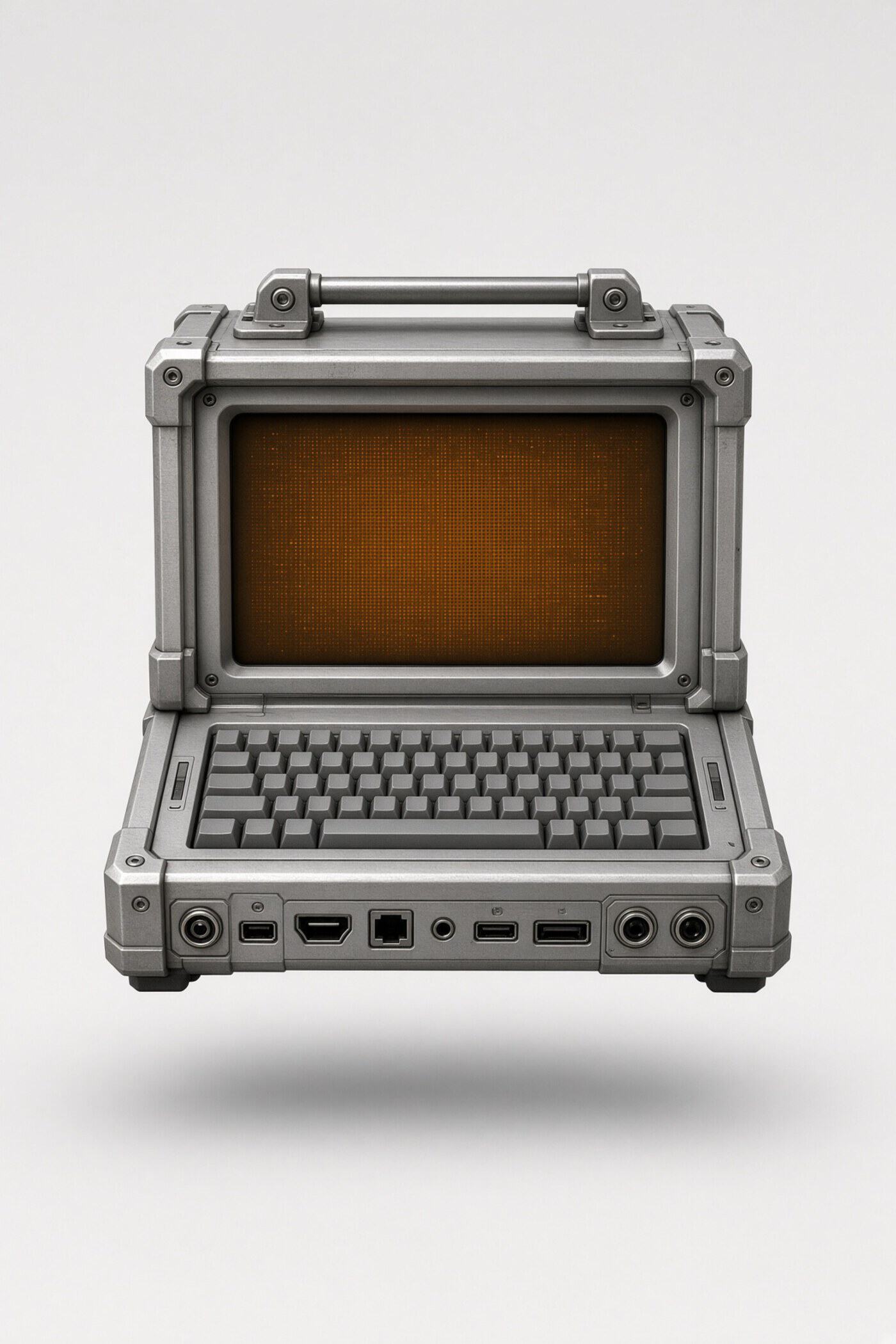
Plate 2 · The range
The Mk III is seven years into production and still outsells the Mk IV with anyone who works outdoors. It is sealed to a standard the Mk IV is not.
Specifications for all five marks side by side, memory boards and accessories with part numbers, and what is actually on the shelf this week.
Plate 3 · The constraint
Every honest specification sheet in this industry says the same thing in different words: you will run out of memory before you run out of anything else. Link rate and latency can be bought with a better layout. Memory is graded, matched silicon, and there is never enough of it.
So we print two numbers, what is fitted and what the bus will take, and we tell you when the second number is a bad idea. The Mk III will physically accept a 24 MB board. We will still suggest a Mk IV, because the scheduler on a Mk III was designed around four resident programs and paying us for a board does not change that.
Firmware, the ICE reserve and scratch take twelve megabytes of a Mk IV before you load a single program. Twenty are left for warez. We would rather you read that here than discover it in the field with a Sentry waking up.
Mk IV, CS-4D-032. ICE reserve is fixed and cannot be paged out.
Plate 4 · Service
Fenn Street has been taking in other people’s decks since 2011 and it still does, including our competitors’. Nothing is fitted until the figure on the docket has been agreed.
| Level | Code | Acknowledge | Turnaround | Loan deck | Charge |
|---|---|---|---|---|---|
| BenchThe default. Post it or bring it in. | CS-SV-B | 1 working day | 10 working days | No | Diagnosis 40 cr, credited against the repair |
| PriorityFor a deck someone is waiting on. | CS-SV-P | 4 working hours | 3 working days | On request, same mark | 180 cr per docket, plus parts |
| Field exchangeFleets of six or more. Ask for terms. | CS-SV-X | 2 working hours | Next working day, replacement deck | Included. You keep the replacement | Contract, from 1,400 cr per deck per year |
Bench SLA is ten working days. Median 6.2 days, 94.1 % inside. Published monthly, including the months we miss.
We hold service parts for ten years after a mark is withdrawn. The Mk I came off the line in 2021 and is serviced until 2031.
Including Nitrosoft, out of warranty. We tell you before we open it whether we think it is worth the labour.
Plate 5 · House style
Every figure is measured at the works, on production hardware. The numbers that got worse are printed in the same size as the numbers that got better.
The Mk V is heavier than the Mk IV and runs half an hour shorter on a cell, and both are on its page, in the table, above the good news. Nitrosoft publish benchmarks too. Their decks are quick, and the figures held up when we measured several of them ourselves. A Mk IV bought this year will still have parts in 2039.
Every figure on this site was measured at Bay 4 on production hardware · Revision D data set · 2029